
Basic Bach Literacy
Study of Bach's music involves not only a basic literacy in music and theology, but also terminology and compositional techniques.

Bach's music is both awe-inspiring and intricate, and understanding its vocabulary is essential to appreciating its depth. Below, we’ll explore some foundational terms to help you navigate Bach’s world with confidence. These will show up again and again throughout our study of his music.
Definitions
Recitative
Think of recitative as the “dialogue” in a musical drama. It's a style of vocal music that mimics the rhythms and patterns of speech, often used to advance the plot in operas, cantatas, or oratorios. In Bach's works, recitatives are usually accompanied by minimal instrumentation—often just a continuo (more on that below)—to ensure the focus remains on the words. They are concise, functional, and contrast sharply with the more melodic arias.
Aria
An aria is the star of the show—a solo vocal piece designed to express a single emotion or idea in a more elaborate and melodic manner. Unlike the straightforward recitative, an aria is rich in ornamentation and lyrical beauty. In Bach’s cantatas, arias often feature intricate interplay between the voice and instrumental accompaniment, showcasing both technical skill and emotional depth.
BWV (Bach-Werke-Verzeichnis)
BWV stands for Bach-Werke-Verzeichnis, which translates to "Bach Works Catalogue." It’s a system for organizing Bach's compositions, created by Wolfgang Schmieder in 1950. Each piece is assigned a unique BWV number. For example, the Brandenburg Concertos are BWV 1046–1051, while the beloved Toccata and Fugue in D minor is BWV 565. Unlike opus numbers, BWV numbers are grouped by type of work, not chronology.
Cantus Firmus
Latin for “fixed song,” a cantus firmus is a pre-existing melody that serves as the foundation for a composition. In Bach’s time, these melodies were often drawn from hymns or Gregorian chant. Bach ingeniously wove cantus firmus melodies into his works, using them as a structural anchor while building complex polyphony around them. A famous example is the hymn "Luther's Ein feste Burg," which Bach used in his Cantata BWV 80.
Chorale
A chorale is a hymn tune, often with a simple, singable melody, designed for congregational singing in Protestant church services. Bach elevated chorales to high art by harmonizing them in innovative ways. In his cantatas and Passions, chorales often appear as moments of reflection, inviting the listener to meditate on the spiritual message. His harmonizations have become iconic, studied by musicians for their mastery of voice leading.
Continuo (Basso Continuo)
The continuo, or basso continuo, is the backbone of Baroque music. It’s a system of improvised accompaniment where the bass line is played by instruments like the cello or bassoon, while harmonic support is provided by a keyboard instrument like the harpsichord or organ. The continuo provides the harmonic foundation, allowing the melody and counterpoint above to shine. In Bach’s works, the continuo is omnipresent, providing both structure and drive.
Compositional Techniques used by Bach
Word Painting
Word painting is the musical equivalent of storytelling through sound. Composers use it to enhance the meaning of lyrics by mirroring the words in the music. For instance, ascending notes might depict rising, while a descending melody could evoke falling.
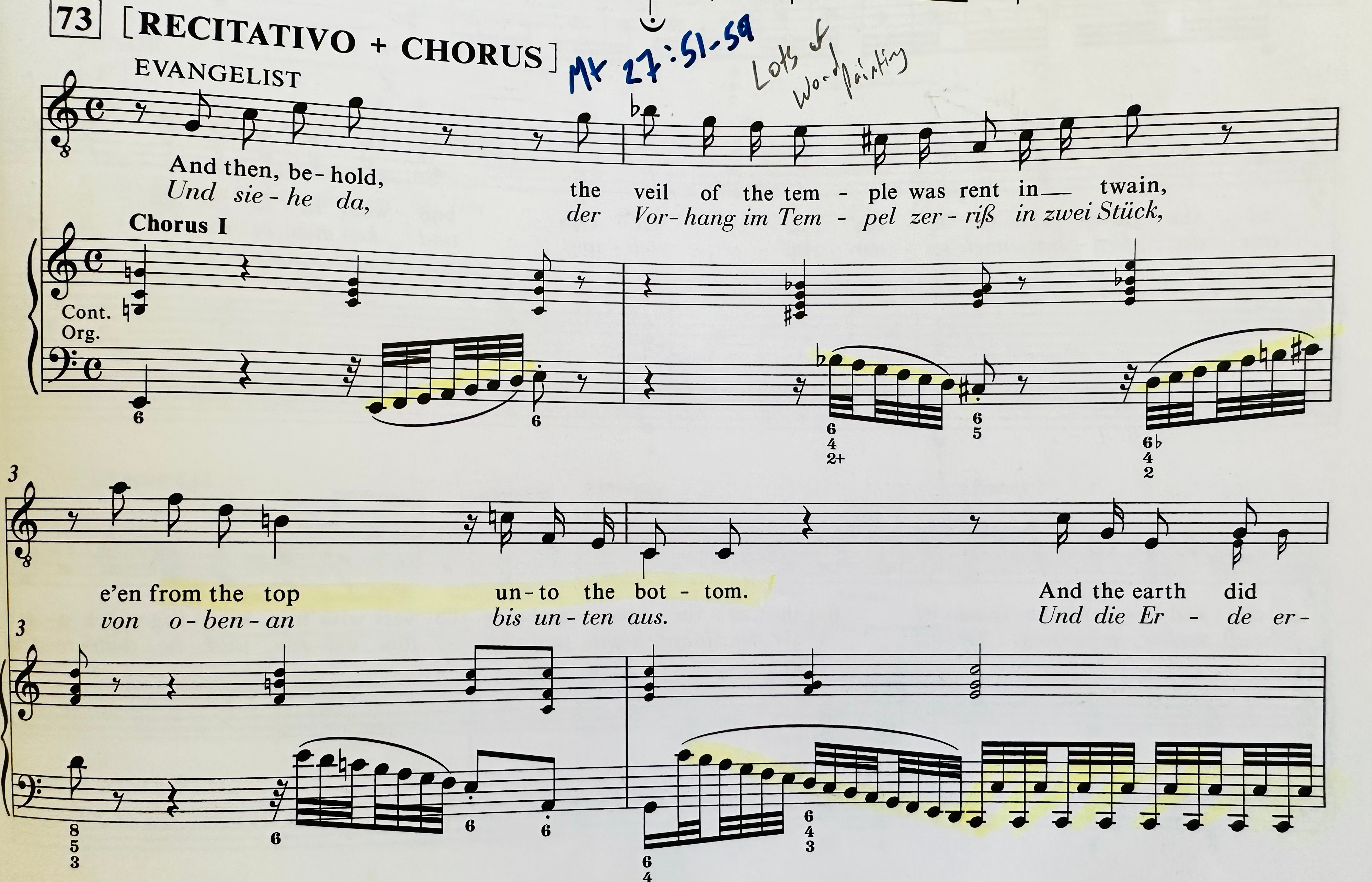
Bach’s creativity in how he deployed this technique is exquisite and expansive. A careful study of each note and how it relates to the text is an enjoyable pursuit. When you do so, you’ll see how Bach writes high notes for angels and rulers and low notes for death and the grave. He uses chromaticism and dissonance to indicate man’s sinfulness and consonant harmony for divinity.
How Bach Used It: Bach was a master of word painting, especially in his vocal works. In his St. Matthew Passion, the word "weinen" ("weeping") is set to a descending melodic line that resembles the act of crying. As Christ stumbles to Golgotha with his cross, Bach writes staggered rhythms interspersed with droplets of blood. It is a striking effect. Similarly, when referencing "darkness" or "death," Bach often employed minor keys or dissonant harmonies to emphasize the text’s gravity. These musical choices bring the text to life in a vivid, almost cinematic way.
In the image below, you can see how Bach writes for the moment after Christ’s death in Movement 73 of the Saint Matthew Passion. The veil of the temple is torn in two by a two-octave run in the orchestra, followed by an earthquake in the low strings.
Listen to Leonard Bernstein conduct the New York Philharmonic in an English performance of this movement:
Key Centers
A key center, or tonal center, refers to the main pitch or "home base" of a piece of music, around which all other notes and harmonies revolve. Each key has a unique character and emotional quality—for example, D major often conveys triumph, while B minor can evoke introspection.
How Bach Used Them: Bach’s use of key centers was nothing short of genius. In The Well-Tempered Clavier, he explored all 24 major and minor keys, showcasing their individual colors while proving the possibilities of equal temperament. In larger works, Bach often used key relationships to structure movements or create dramatic tension. For instance, he might begin a cantata in a major key and shift to the relative minor to mirror the narrative’s emotional arc. Bach would use key centers as points of connection from one movement to another, or to tie distant movements together. For example, the final chorale after Jesus’ death in the Saint Matthew Passion resolves in the same key as its initial hearing.
Orchestration
Orchestration is the art of assigning specific musical ideas to particular instruments, using their unique timbres to enhance the overall effect of a piece. During the Baroque era, orchestration was often more flexible than in later periods, but Bach’s choices were always purposeful.
How Bach Used It: Bach’s orchestration demonstrates his deep understanding of instrumental capabilities. In his Brandenburg Concertos, each concerto features a unique instrumental combination, from the virtuosic trumpet in the Second Concerto to the intimate pairing of violins and violas in the Sixth. In vocal works, such as his cantatas, Bach’s orchestration often underscored the text’s meaning: flutes might symbolize purity or innocence, while strings were used to indicate divinity or warmth. Instruments playing together in unison or in close harmony might suggest agreement, while those echoing each other might be illustrative of dialogue.
Counterpoint
At the heart of Bach's music is counterpoint, the art of combining independent melodic lines that harmonize with one another. Bach’s fugues, like those in The Well-Tempered Clavier or The Art of Fugue, are masterclasses in counterpoint. Each voice enters successively with the main theme (the subject) and intertwines in complex yet harmonious ways.Counterpoint often shows up in his larger-scale works as an indicator of the Law.
Gematria
Gematria is a numerical system where letters are assigned specific numerical values, often used in religious and mystical contexts to uncover hidden meanings in words or texts. In Bach’s time, Gematria was sometimes applied to music, especially by composers interested in symbolism and numerology.
How Bach Used Gematria
Bach frequently incorporated Gematria into his music, reflecting his theological interests and his fascination with numerical symbolism. His own name provides a famous example:
In the German alphabet, the letters B-A-C-H correspond to the numbers 2, 1, 3, and 8. When added together, they total 14—a number Bach seemed to regard as significant. He even signed some of his works with the number 14 as a personal emblem.
Bach also used numbers to encode theological meanings:
The number 3, representing the Holy Trinity, is often reflected in triple meter or three-part structures.
The number 7, symbolizing divine completion, appears in key thematic moments in works like the St. Matthew Passion.
The number 10 appears to reflect completeness or to reference the Ten Commandments.
While Gematria in Bach’s music might not always be obvious to the listener, it underscores his intention to imbue his compositions with deeper layers of meaning, both musical and theological.
Final Thoughts
This is by no means an exhaustive list of Bach’s approaches or techniques. Having these basic concepts in mind when you examine his compositions will help you to better understand the depth of his intent as he created his music for the church.
It is possible that your knowledge of the German language may be a barrier. There are many YouTube videos out there of cantatas with subtitles. You might also consider the Bach Cantatas Website for translations of texts and much more information.
-Soli Deo Musica!